

Volunteers prepare for Ypsi PRIDE Day
May. 13, 2010 · 7:09 a.m.

Each year, residents in and around the city of Ypsilanti carry on a tradition started by a group of community members enrolled in a city leadership program, a sort...read more
Bicycles zoom as flowers bloom
Apr. 30, 2010 · 2:11 p.m.

The weather has turned, the trees are budding and the flowers are popping out of the ground; time for a cruise through town. But don’t be so quick to hop in the...read more
Sheriff Clayton visits Ypsilanti Township
Apr. 29, 2010 · 12:59 p.m.

About 50 Ypsilanti Township residents gave the Washtenaw County Sheriff Office their input about law enforcement in the community Tuesday evening.
The information...read more
Local photographer raising funds for Ypsi Project exhibit
Apr. 20, 2010 · 2:20 a.m.

Ypsilanti has many faces, and Erica Hampton wants to share a few of them with you.
Over the past year, Hampton created the The Ypsi Project, a series of portraits...read more
Savoy taking shape as live music venue
Apr. 17, 2010 · 2:38 p.m.

Ypsilanti's newest concert venue is preparing for its grand opening weekend April 23, more than a month after its soft opening March 13.
Formerly Club Divine,...read more
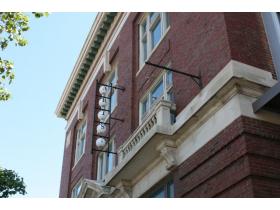 Photo by Christine Laughren
The building that houses the Riverside Arts Center downtown turns 100 years old this year. Formerly a Masonic temple, the globes on this sign were used to show one of five Masonic groups were using the building.

Former Masonic temple now Riverside Arts Center
Aug. 20, 2009 · 9:39 a.m.
For 100 years, the building at 76 N. Huron St. has served as a meeting spot for Ypsilantians, but not always to catch a play or see an art exhibit.
For the first 75 years of its existence, the building, which now houses the Riverside Arts Center, served as a Masonic temple.
The building, designed by the Grand Rapids architecture firm Osgood & Osgood, was not the first building in Ypsilanti belonging to the Masons. The first Masonic meeting house was located in Depot Town, near the corner of Cross and Ninde streets.
After its completion, the new Masonic lodge had enough room for a bowling alley, card rooms, a theater and a dining area—all things the space in Depot Town was missing.
Since it was built, the building has seen two fires—one in 1925 and another in 1970. The latter having done a great deal of damage to the structure.
“It was such a severe fire, they tore the rear 2/3 of the floors off the building,” said Barry LaRue, member of the Riverside Arts Center Foundation. “That really cut down on the amount of square footage in the building.”
By 1985, the Masons moved out to their current location on Whitaker Road and sold the building to Reynold Lowe, owner of Materials Unlimited.
In addition to using the building as storage space, he also used part of the building as a glass studio. The basement cafeteria was converted into a woodworking shop.
“I went through it with the [Downtown Development Authority] and it was filled with cast iron tubs,” LaRue said of the building.
In 1994, Lowe put the building up for sale. LaRue and others, acting on recommendations from HyettPalma, a consulting firm specializing in enhancing business districts, decided the building would be a good spot for an arts center.
“They wanted to see more culture and entertainment,” LaRue said of HyettPalma’s advice.
“There was a strong interest in the arts, particularly in local theater,” he added.
After the Riverside Arts Center took over the building, renovations were done. However, the RAC did decide to keep some of the unique aspects of the historic building.
For instance, there are a series of white globes attached to the building that now say “A-R-T-S-!.” When the Masons owned the building, each of the Masonic organizations was assigned one of the globes. When a globe lit up, it meant the assigned organization was meeting that day.
“What I think we’ve done is help support the cultural life in our community and save a historic building,” LaRue said.
The RAC has not only made renovations and changes to the building, but have also expanded the amount of space they have available. They recently annexed the neighboring Edison Building and built an elevator connecting that building to the main structure.
To do all this, the RAC has had to rely on donations as well as money from grants. While he did not have an exact figure, LaRue suggested the RAC has taken in more than $1 million in assorted contributions.



© 2010 The Mojo News Group - Ypsilanti Citizen Home - About Ypsilanti Citizen - Contact Us - Advertising - Calendar - Archives - Terms of Use
