
Thank you Ypsilanti
Jun. 23, 2010 · 5:07 p.m.

The Ypsilanti Citizen was launched in November 2008 to inform the Ypsilanti community about the news and events that were happening in their area.
Since our launch,...read more
Crossroads Summer Festival; rockin’ ladies night
Jun. 23, 2010 · 4:37 p.m.

A special Ladies Night was held Friday at the 2010 Ypsilanti Crossroads Summer Festival in conjunction with the American Cancer Society’s Relay for Life.
Just...read more
Crossroads to hold Ladies Night for Relay for Life
Jun. 16, 2010 · 9:13 a.m.
On June 11, the 2010 Ypsilanti Crossroads Summer Festival featured a rousing opening set from roots and blue grass band Dragon Wagon.
Dragon Wagon was joined on...read more
Electric rail pollution leads to dirty laundry
Jun. 15, 2010 · 11:42 a.m.

Maggie Smith was not looking forward to a forenoon of sewing pleats.
She put down her newest customer’s summer dress. Downstairs, she offered to get potatoes...read more
EMU students in wartime
Jun. 1, 2010 · 10:32 a.m.

Leroy Grindle was an Ypsilantian soldier who lost his life in WWII. He was a member of the Michigan Normal (EMU) class of ’41, and is memorialized with a black...read more
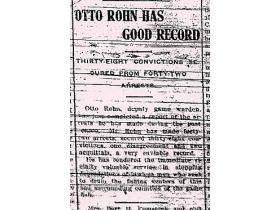 Photo by Ypsilanti Archives
Otto's exploits periodically made the paper.

To the Archives
Jan. 26, 2010 · 2:34 a.m.
Ypsilanti’s most tenacious hunter was Otto Rohn. He hunted other Ypsilantians. He caught many, as deputy game warden.
The job wasn’t lucrative. Rohn lived with his wife Amelia at 101 Lincoln, in a small house on a dirt road in a poor section of Ypsilanti.
His true home, however, was in the snowy pine forests, iced-over lakes, and quiet wilderness surrounding Ypsilanti. There he followed footprints in the snow and silently hid behind trees, closing in on poachers.
In the winter of 1907, Rohn lay motionless for hours on frozen marsh-ground south of town, concealed amid the reeds and marsh hay near a canal bank. The wind moved through the grasses in a dry rustle as a few flakes of snow floated down.
Rohn spied his prey. He saw a knife flash in one man’s hand as he skinned a muskrat. Rohn heard laughter. He watched three men seal their fate.
The Monroe Marsh at the mouth of the Raisin River was coming to the end of its decades of renown as a rich hunting and fishing ground. Pollution and encroaching industry were damaging the marsh. Native Americans had once fished there for sturgeon, and trapped beaver and muskrat.
By the mid 1800s, “market hunters exploited the abundant aquatic resources of the marshes, harvesting waterfowl by the thousands to supply eastern and urban markets,” notes one Monroe Marsh history.
One gunshot often brought down multiple birds, and hunters often took several hundred in a single night. This was the lush habitat that Ypsilanti poachers Leon Willetts, Archie Navarre and Harry Duval had snuck into, in search of the water-loving animals whose luxurious toasty fur was used to line ladies’ cloaks and mens’ coats.
The men did not notice that they, too, were prey.
“Rohn went out into the marsh early, on the north side of the canal, and saw the three hunters,” says the Nov. 11, 1907 Ypsilanti Daily Press. “He walked back some distance to get across, then slipped up as near them as he dared and lay there on the wet, half-frozen ground for three hours, until he saw enough to convince him that he was justified in arresting the men.”
Confronting often heavily-armed lawbreakers in the remote wilderness was not a job for the weak. Rohn made up for his relative lack of firepower with considerable grit.
“When he stepped out on the hunters,” says the Press, “he covered them with his revolver, handcuffed two of them together and told the third that if he made any attempt to run away he would shoot him.”
The men weren’t happy with the wily warden, and refused to carry back the dozen ’rats they’d nabbed. Rohn “had to carry the rats back to town, besides watching his prisoners.”
Luckily, wrangling three sullen criminals and a pile of dead beasts single-handedly all the way back to Ypsi was no problem for Rohn. Pending their trial, the men were jailed.
Nabbing the muskratters was not Rohn’s biggest bust. The next January he caught four men “hunting rabbits with ferrets in Washtenaw County,” notes the Jan. 18, 1908 Ypsilanti Daily Press.
This technique used ferrets and nets. The trained ferret entered a rabbit burrow, whose multiple entrances were covered with individual nets. The ferret harassed a rabbit until it fled from the burrow—and into a net. Nabbed by Rohn, Detroiters Louis and Albert Petzoldt and Adrian residents Joe Schwab and Edward Gruscow each paid $10 in fines plus costs ranging from $7.75 to $12.75.
Rohn was also a defender of the humble fish.
Under the headline “Otto Rohn has Good Record,” the Jan. 5, 1910 Ypsilanti Daily press notes, “He has rendered the immediate vicinity invaluable service in stopping depredations of lawless men who seek to drain the fishing centers of this and surrounding counties of the game fish.”
Yet another newsworthy bust appeared in a different town newspaper, the Nov. 17, 1913 Daily Ypsilantian-Press. “Otto Rohn arrested a man by the name of Baylis Sunday afternoon,” says the article.
The Baylises were bad news.
Attached to the Baylis name, in old court dockets and newspaper stories, were numerous crimes that would in 1932 included the murder of Carter Deatherage, a down-and-out alcoholic farm laborer who drifted into Ypsilanti after harvest season, only to meet a deadly fate.
Rohn confronted Baylis. Baylis was no one to treat lightly. It may have been the closest that Rohn had ever come to his own murder.
Unlike the meeker muskrat poachers and the rabbit netters, the foolhardy criminal, holding a highly suspicious object, defied the formidible Rohn.
“Although the young man protested . . . that he had only taken it from a dog, he was promptly escorted to the city jail.”
Baylis’ “dog” dodge collapsed in court two days later. He paid a $10 fine and court costs after pleading guilty to what might be the most pathetic crime in Ypsilanti history: unlawful possession of a squirrel.



© 2010 The Mojo News Group - Ypsilanti Citizen Home - About Ypsilanti Citizen - Contact Us - Advertising - Calendar - Archives - Terms of Use
