

Thank you Ypsilanti
Jun. 23, 2010 · 5:07 p.m.

The Ypsilanti Citizen was launched in November 2008 to inform the Ypsilanti community about the news and events that were happening in their area.
Since our launch,...read more
Crossroads Summer Festival; rockin’ ladies night
Jun. 23, 2010 · 4:37 p.m.

A special Ladies Night was held Friday at the 2010 Ypsilanti Crossroads Summer Festival in conjunction with the American Cancer Society’s Relay for Life.
Just...read more
Crossroads to hold Ladies Night for Relay for Life
Jun. 16, 2010 · 9:13 a.m.
On June 11, the 2010 Ypsilanti Crossroads Summer Festival featured a rousing opening set from roots and blue grass band Dragon Wagon.
Dragon Wagon was joined on...read more
Electric rail pollution leads to dirty laundry
Jun. 15, 2010 · 11:42 a.m.

Maggie Smith was not looking forward to a forenoon of sewing pleats.
She put down her newest customer’s summer dress. Downstairs, she offered to get potatoes...read more
EMU students in wartime
Jun. 1, 2010 · 10:32 a.m.

Leroy Grindle was an Ypsilantian soldier who lost his life in WWII. He was a member of the Michigan Normal (EMU) class of ’41, and is memorialized with a black...read more
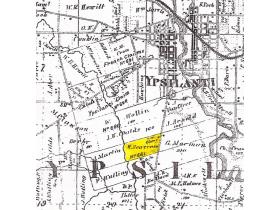 Photo by Ypsilanti Archives
The Seaver farm, seen here in an 1856 plat map, lay just south of the city.

To the Archives
Nov. 17, 2009 · 8:51 a.m.
A farmer, a student, a teacher and a Willow Run trailer resident offer glimpses of Thanksgiving as they celebrated the holiday in the years between the Civil War and World War II.
Despite the traditional stereotype of women spending the day cooking and hosting the dinner, none of the diarists does so, instead celebrating the holiday in different ways.
Mary Seaver was a farmer, who with her husband Hiram raised sheep, hogs and dairy cattle on a farm just south of the city, west off the present-day South Huron Street—just north of the Huron River Drive branch. Her 1863 diary contains brief entries about farm doings, the weather and socializing, written with a graceful script in faded brown ink. She also peppers her diary with 19th century emoticons; her entries for June 17, July 16, Aug. 12, Sept. 9, Oct. 10 and Nov. 3 include mysterious drawings of frazzled-looking frowny faces.
In mid-November 1863, the 35-year-old Mary’s friends Julie and Mattie visit; they all stayed up till one in the morning talking. The next day, Mary and Hiram took their guests for a walk around the Seavers’ farm, “came back, took dinner, cracked nuts & jokes” and then took the women to the Ypsilanti railroad depot and kissed them goodbye.
A few days later, Mary noted she sold 32 quarts of milk and was called on by another friend, Hilory, who invited her to Thanksgiving dinner. Her diary entries for Wednesday the 25th and Thursday the 26th are blank. Perhaps Mary was at Hilory’s home and stayed the night. On the 27th, Mary was apparently back home, and records “today we killed 22 hogs; Mrs. Stuart took the fat off from the innards.”
Eleven years later, 17-year-old high school student Allie McCullough kept a diary at her home on the north side of Michigan Avenue by the river, near the present-day site of Angel Food Catering. Her father owned a metal foundry across the street, on the present-day Water Street property. In November of 1874, Allie was participating in a speech club, then called the Lyceum. She also attended dancing class, of which she said, “Am getting so that I like it better and can do it ever so much better but the worst part of it is having so many come and ask you to dance that you don’t like. . .”
On Nov. 26, Allie celebrated Thanksgiving by attending church services. “The services were very nice. Had a nice time all day. Read a great deal. Never had such a jolly time [in] my life as I did tonight. Lou Gratton and Hattie Bergers were here and spent the evening. I like them real well, much better than I expected.”
Unbeknownst to Allie, it would be the last Thanksgiving she celebrated. She had tuberculosis, then called consumption, and died the following summer.
In 1919, Carrie Hardy taught math at Ypsilanti High School and lived in an apartment at 223 River Street. Her diary reflects school activities, the high costs of wartime goods and the trips she took in her Maxwell car, which she sold on Nov. 18 to buy a Liberty Six coupe for $2,590—about $32,000 today.
On Nov. 27, Carrie “ate Thanksgiving dinner with May Webb, her mother [and] aunt. In P.M. we saw Mary Pickford in ‘Hoodlum,’ at the Martha.” This was the Martha Washington movie theater, now Déjà Vu.
Another wartime diarist, Mary Castle, kept a vivid account of the travails of life in a Willow Run trailer camp during World War II. She kept the diary at the request of U-M sociology professor Lowell Carr and Detroit Institute of Technology sociology professor James Stermer. The men included excerpts of her diary, and others, in their book “Willow Run: A Study of Industrialization and Cultural Inadequacy.”
In November of 1942, Mary describes the difficulties of the crowded communal laundry room, an electrical blackout, frozen sewer pipes and Thanksgiving far from family. Her trailer’s oven was too small for a turkey, so she, her husband John and son Tommy went out to eat downtown, where they paid what she thought was an exorbitant amount for a meager dinner, eating again when they returned home. Food prices in November of 1942 were expensive and would soon be rationed using ration books and stamps. Times were grim, but Mary’s spirit and determined desire to adapt shine from her diary.
This year, many locals will detail their triumphant turkeys and Crisco fiascos on Facebook, Twitter and blogs, adding their contemporary Ypsilanti voices to those echoing out of the past, from as long as a century and half ago.
Laura Bien is the author of "Stud Bunnies and the Underwear Club: Tales from the Ypsilanti Archives," to be published this winter. She also writes the historical blog "Dusty Diary" and may be contacted at ypsidixit@gmail.com.


© 2010 The Mojo News Group - Ypsilanti Citizen Home - About Ypsilanti Citizen - Contact Us - Advertising - Calendar - Archives - Terms of Use
